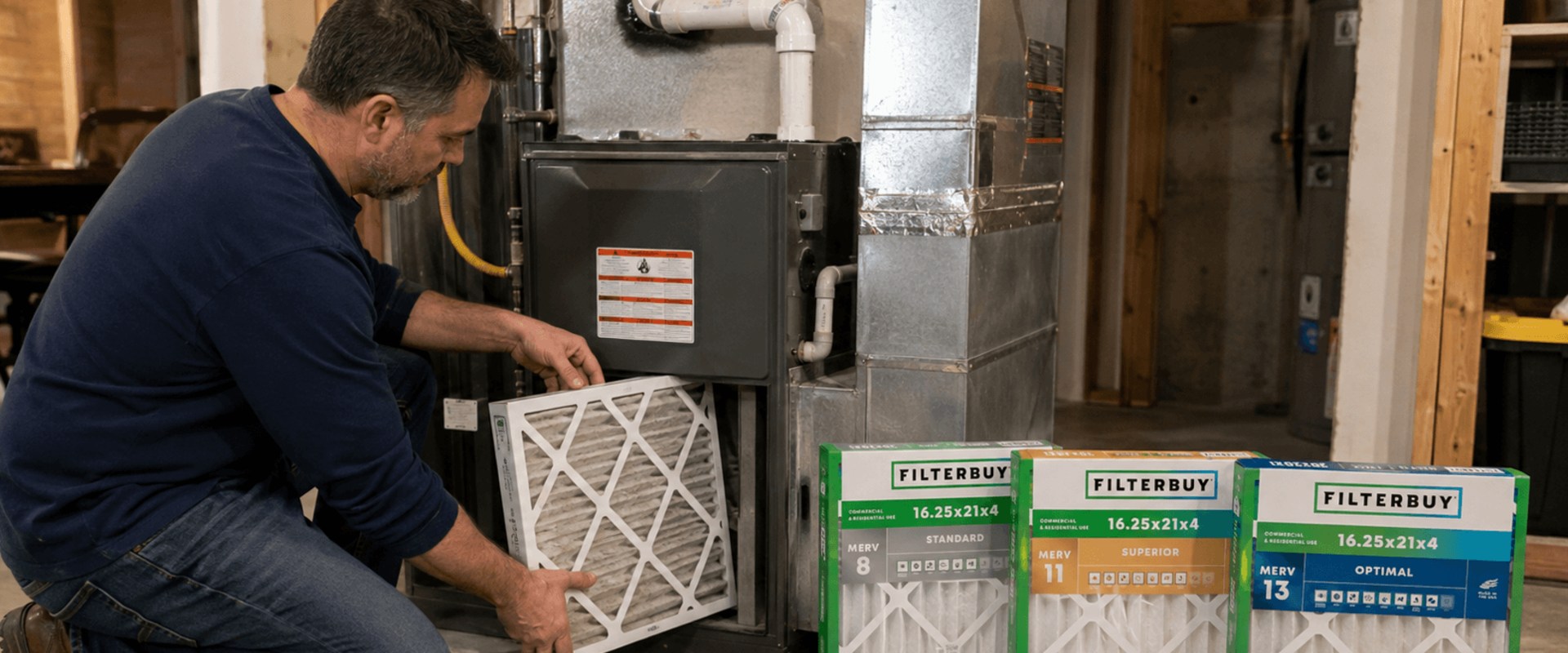
How Often to Change 16.25x21x4 Air Filters
TL;DR
A 16.25x21x4 air filter is a 4-inch media filter, and the box will say 3 to 6 months. In Miami-Dade County, the right answer is 60 to 90 days, because our air handlers barely stop running and our summers import dust from another continent. If your ducts leak, cut it again. Two things most filter pages omit: a used filter is the cheapest duct-leak diagnostic you own, and charged media loses efficiency as it loads, so "it still looks fine" is not the test people assume.
Key Takeaways
● Plan on 60 to 90 days, not the 3 to 6 months printed on a 4-inch box.
● Miami-Dade is a short-interval climate. Thirty-year normals put the county near 77°F annually with roughly 86 days above 90°F, so the system rarely rests.
● Leaky return ducts are the hidden multiplier, pulling attic dust onto the filter.
● Charged media loses efficiency as it loads, so a filter can look fine while underperforming its MERV rating.
● A clean filter is worth 5 to 15 percent of cooling energy, per the U.S. Department of Energy.
How Often Do 16.25x21x4 Air Filters Need Changing?
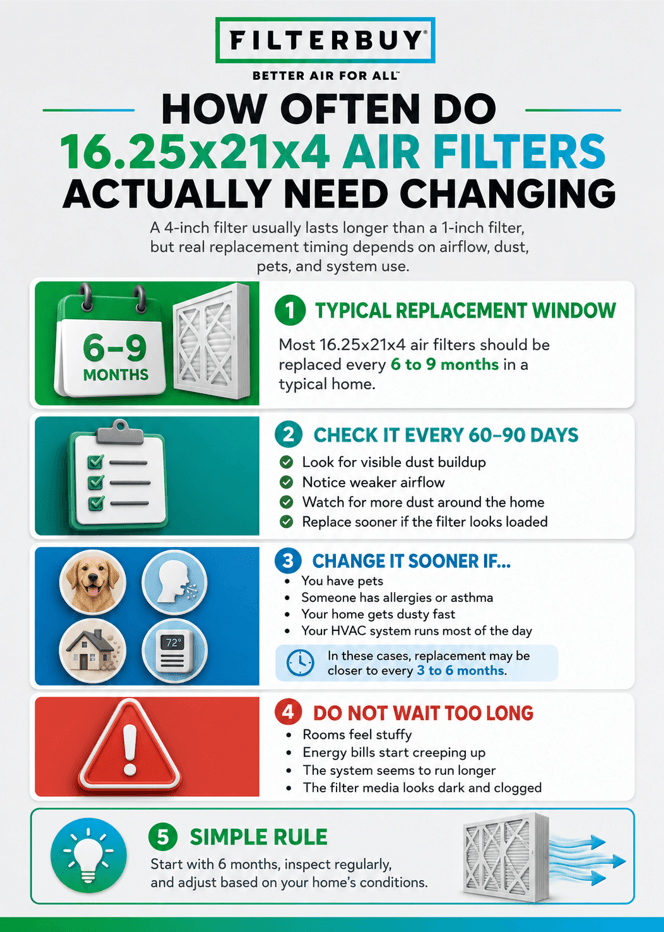
Replace a 16.25x21x4 air filter every 60 to 90 days in a Miami-Dade home, every 90 to 180 days in a mild, low-runtime climate, and every 30 to 45 days with pets, nearby construction, or asthma in the household. The EPA puts the manufacturer norm at 60 to 90 days and adds what matters most: if it looks heavily soiled, shorten the interval.
The reframe almost everyone misses is that the interval is not a property of the filter. It belongs to your house: blower hours, incoming air quality, and whether your ducts deliver filtered air or scavenge attic air. Two identical filters on the same street can be a 45-day filter and a 90-day filter.
Depth is why 4-inch media outlasts 1-inch: more surface area, lower face velocity, more dust held before airflow suffers. Depth buys capacity but does not slow how fast it fills.
Why Does a Filter Load Faster in Miami-Dade County?
Three conditions compress the interval. Runtime comes first: with January averaging around 68°F, our air handlers work in months when a Georgia system sits idle. Humidity is second, turning captured debris into a growth medium rather than inert dust. Summer dust is third, and NOAA reports Saharan Air Layer activity ramping up in mid-June and peaking through mid-August, with outbreaks every three to five days reaching Florida.
So set two intervals, not one. A filter installed between June and August should be checked at 30 days and often replaced at 60. The same filter in November may reach 90 days.
How Do Leaky Ducts Shorten Filter Life?
Leaky return ducts shorten filter life because they let the system draw air from unconditioned space instead of your rooms. A leak in a vented attic pulls in fiberglass, settled dust, and humid air, all of it landing on the filter.
That makes a used filter readable evidence. Greying out under 45 days with no pets or renovation points to return-side leakage. Uneven loading, one edge dirtier than the rest, points to bypass around the frame. A filter that stays clean while the house stays dusty is misread most often: it is being bypassed. Sealing ducts restores a normal workload, the only way a stated interval becomes realistic.
Does a Loading Filter Still Work as Well?
A loading air filter gets better and worse at once, depending on its media. A mechanical filter gains efficiency as it loads, because the dust cake becomes part of the filter. Charged media loses efficiency, because the charge dissipates and fine particles dissipate it fastest. Most residential MERV 11 and 13 panels use charged media.
A 2026 in-situ aging study found mechanical filters gaining efficiency with age, while an electret MERV 13 fell to roughly MERV 10 over six and a half months. Bench testing was gentler, with used MERV 11 filters pulled at one and a half to five months still testing at MERV 11.
The decline is real but gradual, and it compounds with runtime. Appearance tracks pressure drop, not efficiency, and the two come apart. If you bought MERV 11 or 13 for dander, smoke, or Saharan dust, stretching to six months means running much of the year closer to a cheap filter.
Which MERV Rating Should a Miami-Dade Home Run?
MERV 8 is the baseline, MERV 11 is what I recommend for most Miami-Dade homes, and MERV 13 earns its upgrade mainly when someone has asthma. My reasoning is pets and humidity: MERV 11 captures the dander and mold spores that MERV 8 passes, without the airflow penalty that makes MERV 13 a poor match for older air handlers. Rating pulls two ways. On airflow, a higher rating at 4 inches does not shorten the interval, because surface area absorbs the resistance. On efficiency, it may, for the reasons above.
Is 16.25x21x4 the Same as 16x21x4?
No, 16.25x21x4 and 16x21x4 are different filters, and the quarter-inch matters. Catalog sizes are nominal dimensions that round the real panel, so a filter sold as 16x21x4 may not match a cabinet built for a 16.25-inch panel. That gap is a bypass path for unfiltered air.
This is a manufacturer-specific cabinet dimension, not a standard retail one, which is why it rarely sits on a store shelf. Availability is unreliable, and planning around a store run is how people end up with a close-enough filter that leaves a gap.
Filterbuy publishes the actual panel as 16.25 x 21.00 x 3.63 inches in MERV 8, 11, and 13. Measure yours against that spec rather than a printed number, then order online and keep a spare.
What a Filter Change Will Not Fix
A fresh 16.25x21x4 filter will not fix humidity, odors, carbon monoxide, radon, visible mold, a fouled evaporator coil, or crushed ductwork. Pleated media captures particles and protects the equipment downstream. Odors need activated carbon, CO needs a detector, and mold means a moisture source.
How to Calibrate Your Own Interval
Calibrating your own interval takes two filters, about four months, and a marker.
1. Write the install date on the frame before it goes in, and photograph it.
2. Inspect at 30 days. Reinstall if the media is still visible under the dust. Hold it against white paper if unsure, as the American Lung Association recommends.
3. Inspect at 60 days. If the media surface is gone, that is your interval.
4. Inspect at 90 days. Still readable means you have a 90-day house.
5. Recalibrate after a new pet, new roof, duct sealing, or nearby construction.
A home that lands at 30 or 45 days has produced a finding, not a schedule. Treat it as evidence about your ducts.
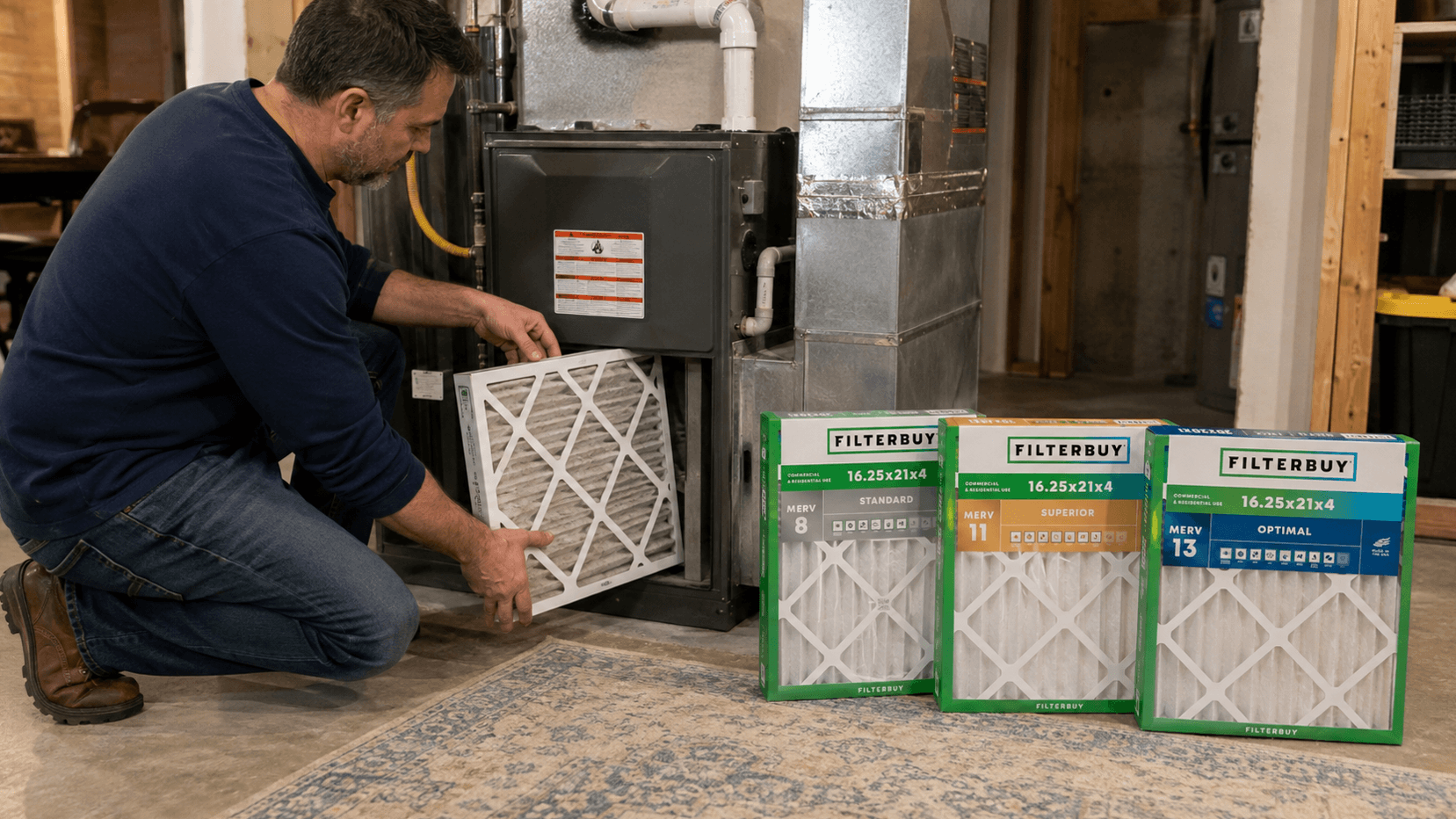
"After a decade of shipping filters into South Florida, we can almost predict the ZIP code from a returned filter. Miami-Dade filters come back grey at 45 days, when the same filter runs a clean 90 in the Carolinas. When a customer says a 4-inch filter is failing early, our first question is whether anyone has tested their return ducts.
-The Filterbuy Team, the American filter manufacturer producing this size in 600-plus dimensions from its Alabama plant
Essential Resources on 16.25x21x4 Air Filters
1. Confirm the exact dimensions before ordering. This size page lists the actual panel dimensions,16.25 x 21.00 x 3.63 inches, with the MERV options and replacement guidance.
Source: 16.25x21x4 Air Filters, Filterbuy
2. Pick the right MERV. The EPA's consumer guide explains how HVAC filters work and settles the question.
Source: Guide to Air Cleaners in the Home, U.S. Environmental Protection Agency
3. Know when summer dust arrives. NOAA tracks Saharan Air Layer timing, so you can move a filter change up before a heavy dust week.
Source: Saharan Air Layer, NOAA Atlantic Oceanographic and Meteorological Laboratory
4. Learn the white-paper test. The American Lung Association explains how to judge a loaded filter and what MERV means.
Source: Air Cleaning, American Lung Association
Supporting Statistics
1. A typical home loses 20 to 30 percent of its duct air to leaks. On the return side, an equal volume gets pulled in from wherever the leak sits, so in a vented attic, your filter cleans attic air too.
Source: Duct Sealing, ENERGY STAR
2. 93 percent of South Census Region households use air conditioning, the highest share nationally. High saturation means high runtime, and runtime uses a filter's dust capacity.
Source: Nearly 90% of U.S. households used air conditioning in 2020, U.S. Energy Information Administration
3. 6.5 percent of U.S. children currently have asthma. In those homes, filtration is a health measure, so set the interval by calendar at six weeks rather than by appearance.
Source: FastStats: Asthma, National Center for Health Statistics
Final Thoughts
The filter industry sells depth as convenience, and in South Florida that promise quietly breaks. A 4-inch air filter is marketed as install-and-forget for half a year. True in Ohio, not in Kendall or Homestead, and the gap is where homeowners lose money running a saturated filter and blaming the AC.
If I could change one habit here, it would be the order of operations: seal the ducts first, then set the filter schedule. Calibrate to a leaky system, and you lock in a number that describes the leak. I would rather someone spend on one duct leakage test than three years of doubled filter purchases, and I say that knowing it is the less profitable advice.
Next Steps
1. Pull your filter today. If the pleats are hidden under dust, replace it now.
2. Measure the panel for width, height, and depth rather than trusting the printed size.
3. Write the date on the new frame, then photograph it at 30, 60, and 90 days.
4. Set your interval where the media stops being visible, and order two at a time.
5. If it greys before 45 days, book a duct leakage test with return-side testing.
6. Seal attic runs with mastic or foil tape, never cloth duct tape.
7. If someone has asthma, run a fixed six-week interval instead of a visual check.
Frequently Asked Questions
Q: Can I stretch a 16.25x21x4 filter to six months in Florida?
A: Rarely. Six months works in a low-runtime climate with sealed ducts and no pets. Here, it restricts airflow long before it comes out.
Q: My filter looks clean at 60 days. Is it still filtering as well as on day one?
A: Probably not, if it is MERV 11 or 13. Charged media fades with use, and appearance tracks pressure drop, not efficiency.
Q: Is changing more often just a way to sell me filters?
A: Going from 90 days to 60 costs about $44 a year at multi-pack pricing, too small to drive the decision. Shorten it for runtime and efficiency, not the filter bill. If your calibration says 90, run 90.
Q: Is it the filter or the ducts?
A: Replace the filter first, the cheap variable. If airflow does not improve, or the new filter greys inside a month, test the ductwork.
Q: Can I vacuum the filter to extend its life?
A: No. Vacuuming damages the fiber structure and the charge, leaving a filter that looks better and works worse.
Set Your Own Interval, Not the Box's
A 16.25x21x4 filter needs changing on your home's schedule, not the label's, and for most Miami-Dade households that means 60 to 90 days. Write the date on the frame next time, and in two months you will know your own number.
Learn more about HVAC Care from one of our HVAC solutions branches…
Filterbuy HVAC Solutions - West Palm Beach FL
1655 Palm Beach Lakes Blvd., Ste 1005 West Palm Beach, FL 33401
(561) 448-3760
https://maps.app.goo.gl/VarpgNZnxuPQuW8A7